Why You Should Avoid Epoxy for Your Pool Deck in the Greater Houston Area
Thinking about giving your pool deck a face-lift before the next long Texas summer? If you've been searching online for pool resurfacing options across The Woodlands, Katy, Sugar Land, Cypress, or Pearland, you've likely come across epoxy coatings. At first glance, epoxy seems like a sleek, durable choice, and yes, it is technically possible to apply it outdoors. But just because you can do something doesn't mean you should.
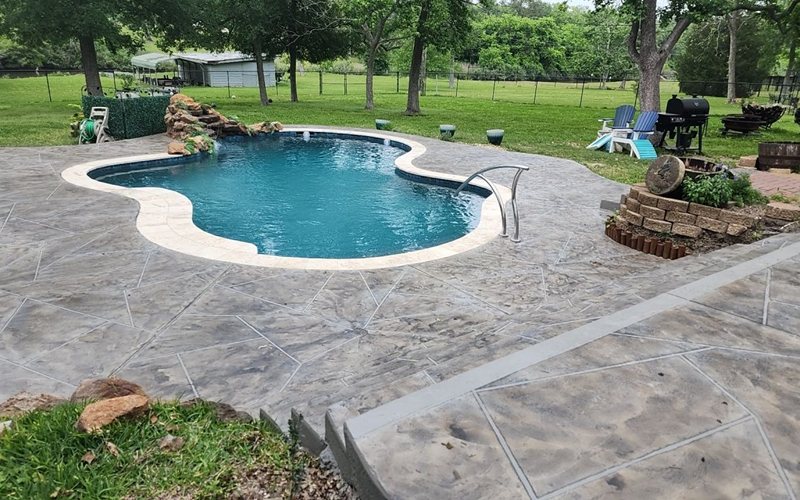 At a residence in Baytown, TX, SUNDEK of Houston used a Tuscan coating to resurface a plain gray pool deck, patio, and set of stairs, transforming it into a beautifully designed outdoor space. (See more of this project here.)
While some general contractors might tell you epoxy is a great choice for pool surrounds, buyer beware: epoxy and outdoor aquatic spaces simply don't mix well over time, especially given the extreme heat, humidity, and sun exposure in Southeast Texas.
Unfortunately, Houston-area homeowners often invest significant money into epoxy surfaces, only to face major headaches, yellowing, and peeling epoxy after just a season or two. Before making a costly mistake, here is what you need to know about the downsides of epoxy pool decks, and what to choose instead.
Get a free quote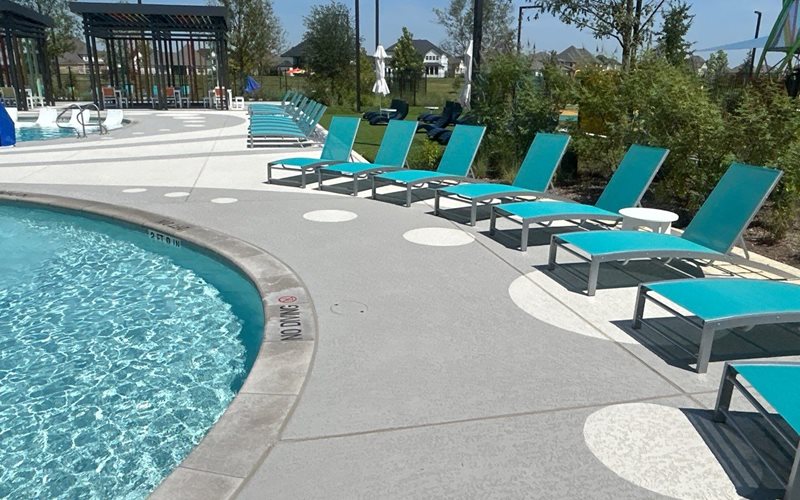 At Longwing Landing, a community pool area at Bridgeland in Cypress, TX, SUNDEK of Houston brought the designers' vision to life using Classic Texture. (See more of this project here.)
WHY EPOXY COATINGS AREN’T A GOOD SOLUTION FOR POOL DECKS
Contractors who advocate for epoxy pool decks usually try to solve its inherently smooth, slick nature by broadcasting sand or aluminum oxide into the topcoat for traction. While this grit provides initial slip resistance, it isn't a permanent fix. High foot traffic, heavy pool water exposure, intense Gulf Coast rainstorms, pool chemicals, and routine power washing rapidly wear away these broadcast aggregates. Once that grit wears down, you are left with a bare, dangerously slick glass-like surface surrounding your pool.
Beyond slipperiness, standard epoxy faces two major environmental enemies in our region:
Blistering UV exposure and severe heat
Continuous exposure to intense Texas ultraviolet rays causes standard epoxy to amber, yellow, chalk, and peel. Furthermore, epoxy absorbs heat, making the surface scorching hot and painful for bare feet.
Trapped moisture and Gulf Coast humidity
Greater Houston's high humidity and frequent heavy deluges mean underlying concrete slabs stay saturated.
Because epoxy is not engineered to handle Southeast Texas climate demands, be wary of contractors who recommend it for outdoor applications. Choosing a surface engineered specifically for pool environments saves you from premature tear-outs and costly full replacements.
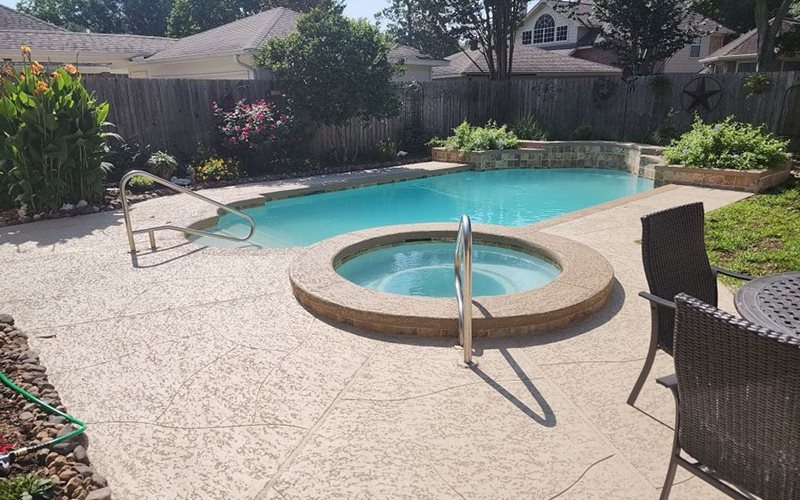 SUNDEK of Houston used Classic Texture and a Custom Scoreline technique to reduce the likelihood of future cracking for this residential pool deck.
BETTER POOL DECK OPTIONS FOR HOUSTON-AREA HOMEOWNERS
At SUNDEK of Houston, we prioritize safety alongside aesthetics by adhering strictly to ADA standards for surface safety. Serving pool owners across Harris County, Fort Bend County, Montgomery County, and surrounding areas, our team uses decades of hands-on local experience to steer you away from high-risk choices like epoxy.
- Classic Texture: Often referred to as "knockdown texture," Classic Texture offers a textured finish that is slip resistant and also stays much cooler than concrete, brick, tile, and other materials.
- SunSplash: This spray-on acrylic finish is applied without the knockdown troweling step and has customizable decorative effects.
- SunStamp: Mimic the look of stone, slate, brick, or wood.
- Tuscan: A thin coating that's troweled on for an artistic, freeform look.
- SunPlay: A cushioned, slip-resistant pool deck coating that provides a soft, cushiony feel underfoot.
- SunCoat: Provides a durable, UV-resistant finish that holds up to heavy foot traffic, sun exposure, and the demands of active use.
- SunSand: Incorporates fine aggregates such as glass beads or aluminum oxide into the finish coat to provide maximum traction.
To learn more about these proven surfaces and find the perfect match for your backyard, check out our detailed guide on the best coatings for resurfacing pool decks.
Contact us about your pool resurfacing project
If you're looking for a contractor who can resurface your pool deck, we'd love to help!
At SUNDEK of Houston, we service all the major cities in the area including Houston, Missouri City, Pasadena, Baytown, Sugar Land, Pearland, League City, Katy, Aldine, Spring, The Woodlands, Humble, Meadows Place, Mission Bend, Cinco Ranch, Bellaire, Deer Park, La Porte, Cypress, Jersey Village, and the surrounding areas.
Call us: (281) 859-4696
Email us: [email protected]